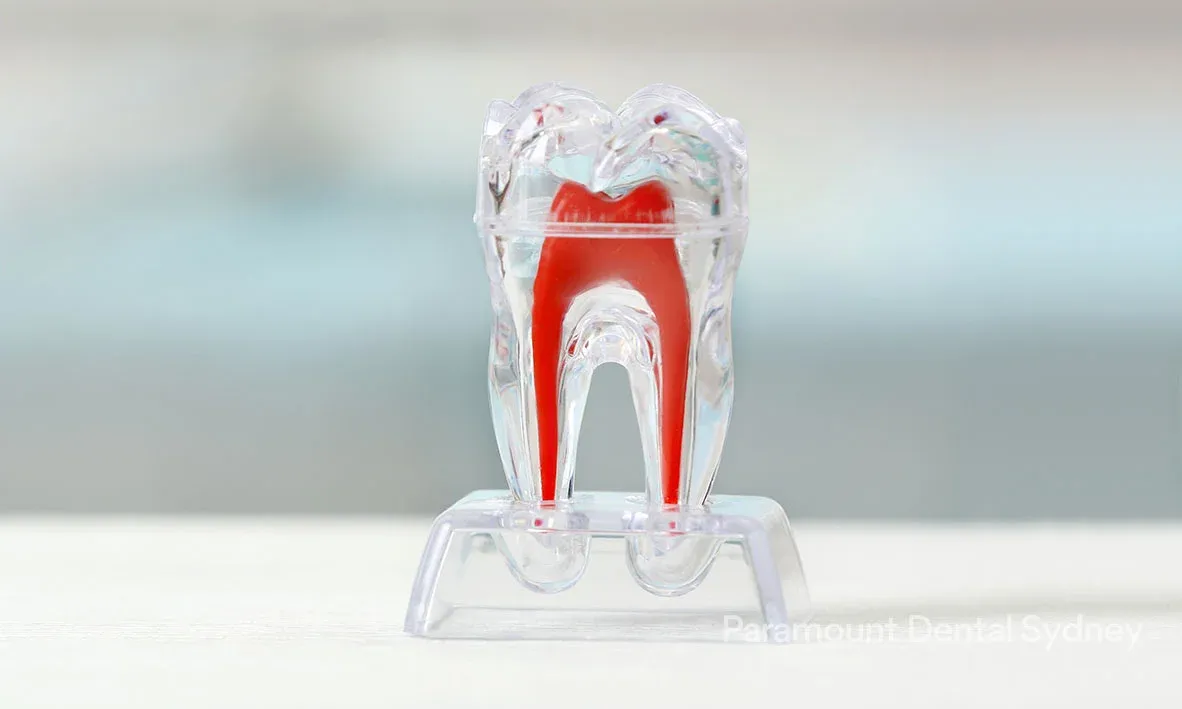
Pulpotomy (Baby Root Canal)
A pulpotomy, often called a baby root canal, removes the infected or inflamed nerve from the top of a baby tooth to stop the pain and save the tooth. Dr. Elmore performs pulpotomies at our Maitland office, with numbing or under sedation, for children from Orlando and across Central Florida.
What it is
A pulpotomy is a procedure that removes infected or inflamed pulp tissue (the nerve and blood vessels) from the crown of a baby tooth while keeping the healthy pulp in the roots. Parents often hear it called a "baby root canal," though it is simpler than an adult root canal because the root pulp stays in place. The American Academy of Pediatric Dentistry (AAPD) describes it as a standard way to save a baby molar when deep decay reaches the nerve but the roots are still healthy. It can also be used on young permanent molars whose roots haven't finished forming.
How it works
After the tooth is numbed, the decay is removed and the pulp chamber is opened. The inflamed pulp in the crown is gently removed and the bleeding is controlled, which tells the dentist the remaining root pulp is healthy. A medicated material, such as MTA (mineral trioxide aggregate), is placed over the root pulp to protect it and help it heal, and the tooth is sealed. Because a treated baby molar is weaker, it is then covered with a crown, usually a stainless steel or tooth-colored crown, in the same visit.
What to Expect, Step by Step
- Exam and X-Ray: Dr. Elmore examines the tooth and takes an X-ray to confirm the decay reaches the pulp and that the roots and bone are healthy. We explain the plan and the crown options before anything begins.
- Comfort and Numbing: A numbing gel goes on first, then local anesthetic, so your child feels pressure but not pain. Children who are very anxious, very young or need several teeth treated can have the pulpotomy done under sedation, often finishing all their treatment in one visit.
- Remove the Inflamed Pulp: The decay is removed and the inflamed pulp is cleared from the crown of the tooth, leaving the healthy root pulp. A medicated material is placed to protect the remaining nerve and help it heal, and the tooth is sealed.
- Crown and Bite Check: A crown is placed over the tooth to keep it from breaking and to seal out bacteria, which is key to long-term success. The visit usually takes 30 to 60 minutes per tooth, and your child goes home the same day.
How it helps
A pulpotomy relieves toothache quickly and stops infection from spreading to the gums, the bone or the permanent tooth developing underneath. Baby molars usually stay in the mouth until about age 10 to 12, so saving one keeps space for the adult tooth, protects chewing and supports clear speech. Published studies report high long-term success rates for pulpotomies in baby molars when the tooth is a good candidate and is sealed with a crown. Saving the tooth can also avoid an extraction and the space maintainer that may follow.
Pulpotomy vs. Pulpectomy vs. Extraction: Which Is Right for Your Child?
Pulpotomy: Partial Nerve Treatment: Removes only the inflamed pulp in the crown and keeps the healthy root pulp. It's the most common choice for a baby molar with a deep cavity and reversible inflammation, takes one visit and is followed by a crown. Pulpectomy: Full Nerve Treatment: Removes the pulp from both the crown and the roots, then fills the canals with a material the body can absorb as the baby tooth loosens. It's used when infection has reached the roots but the tooth can still be saved, and it's the closest thing to an adult root canal. Extraction and a Space Maintainer: If the tooth is badly broken, infection has damaged too much bone, or the tooth is close to falling out, removing it may be best. When a baby molar is lost early, a space maintainer may be needed to keep neighboring teeth from drifting into the adult tooth's space. How Dr. Elmore Decides: The choice depends on your child's symptoms, the X-ray, how the pulp looks during treatment, how long the tooth has before it falls out and your child's overall health. Sometimes the final call is made during the procedure, and we'll explain any change in plan clearly.
Who It's For
Who Needs a Pulpotomy?
Deep Decay Reaching the Nerve
When a cavity in a baby tooth is deep enough to reach the pulp, a filling alone can't seal it off. Baby teeth have thinner enamel and larger nerves than permanent teeth, so decay gets there faster. A pulpotomy removes the affected nerve tissue so the tooth can be restored.
Pain With Sweets, Cold or Chewing
Toothache that comes and goes with sweets, cold drinks or chewing is a common sign of an inflamed but still-living pulp, the stage when a pulpotomy works best. Constant throbbing, pain that wakes your child at night, or swelling can mean the nerve is too damaged, so call us right away.
Healthy Roots and Bone
A pulpotomy only works when the roots and surrounding bone are healthy. Dr. Elmore uses an X-ray and a clinical exam to check for infection at the root tips, an abscess or root breakdown. If infection has spread, a pulpectomy or extraction may be the better choice.
A Tooth Worth Saving
If the baby tooth still has years left before it falls out, saving it keeps space for the permanent tooth and helps your child chew and speak normally. Teeth close to falling out on their own may simply be monitored or removed instead.



Baby Root Canals in Maitland
How a Pulpotomy Saves a Baby Tooth
With the tooth fully numbed, the infected pulp is removed from the crown of the baby tooth, the healthy root is left in place, and the space is filled with a medicated material and covered with a crown. It usually takes 30 to 60 minutes in one visit. At our Maitland office, just north of Orlando, a pulpotomy can also be part of a comprehensive visit under sedation for children from Orlando and across Central Florida.
Mild soreness for a day or two is normal, and children's pain reliever usually helps.
⭐⭐⭐⭐⭐ 5 MILLION STARS for Dr. Elmore and her amazing team! ⭐⭐⭐⭐⭐ I honestly cannot say enough wonderful things about Dr. Elmore and her entire team. My son is autistic, non-speaking, and requires special care when it comes to medical and dental procedures. He has been under Dr. Elmore’s care multiple times over the past few years, and every single experience has been absolutely amazing. Dr…

M C
Google review · Sep 2026
Dr. Elmore es una dentista exepcinal, especialmente con niños de necesidades especiales. Mi hijo tiene autismo y sindrome de Down, asi que no es facil encontrar a dentistas que trabajen bien con estos niños. La Dr. Elmore tambien tiene un niño con autismo asi que sabe como tratarlos. Si necesitan, puede hacer el trabajo dental bajo anestecia en el hospital. Ella es una doctora que se preocupa…

Zuimdie Guerra
Google review · Sep 2026
Dr A Elmore staff and services were 2nd to none. I recommend her to everyone especially if your child has specific dental needs she and her staff were very accommodating, professional and super nice. We really appreciate you thank you so much for a great visit 😄

James Franceschetti Jr.
Google review · Sep 2026
Amazing experience. Dr. Afsoon made sure we understood the process and answered all our questions over the phone as well as the day of treatment. Everything was smooth and the whole team was super profesional and kid friendly. My son never complained of pain afterwards and can now speak better and not drool as much. Thank you Dr. Afsoon and Team! Before and after pictures below 😍

Stephanie V
Google review · Sep 2026
My goodness dr. Elmore & her staff were a 10/10 truly ! Not a single bad thing to say , my son is on the spectrum & hadn’t been able to go to a dentist , dr. Elmore took such good care of him , he was super comfortable , process went smooth & they walked me through the whole process. Highly recommend !

Anilsa Ortiz
Google review · Apr 2026
My 4 year old girl has been terrified of the dentist. She has not been complaining about pain but for the past 6 months her eating habits were terrible. She finally was able to have X-rays taken, and we were confirmed that she had cavities in her molars. The entire staff at this hospital is amazing and so caring! Dr. Elmore talked me through the entire procedure and answered all my questions…

Marie Deaver
Google review · Apr 2026
We had a great experience with Dr. Elmore and her staff. Dr. Elmore took the time to listen to my concerns and answered all my questions. I felt very comfortable and confident in the care my daughter received. Highly recommended! Also wanted to thank Andrea! Due to a reaction my daughter had after a prior surgery with a different provider, I had a lot of concerns and needed to submit some extra…

Alex Larson
Google review · Feb 2026
Dr. Afsoon Elmore, DDS Is the best oral surgeon for kids that I know of. She is so caring, concerned, and most of all helpful through the surgerical process. She has always made herself available for any concerns I may have had. Thank you Dr. Elmore and your team is the best. I highly recommend Dr. Elmore for your child surgerical needs.⭐️⭐️⭐️⭐️⭐️

Jeannette Killingsworth
Google review · Aug 2025
Dr Elmore is absolutely fantastic. She is so compassionate towards the children. You can tell she truly cares, and loves the children. She is passionate about dental care and she even called after 9pm to check up on my child after the surgery. It’s sad that Florida dental care is so bad and we rank almost last in dental health and also access to dental care for those in poverty. If you don’t have…

Alicia Ruiz-Webb
Google review · Feb 2025
Dr. Elmore is God sent she really did a phenomenal job I feel so grateful for the work she did on my daughter. Between the nurses before and during surgery to post op they were constantly communicating with me informing me step by step procedures and I felt super comfortable. It was my daughter’s first time ever being in surgery and I thought I was going to be scared or crying and it was the…

Vicquel Figuereo
Google review · Dec 2024
I dont have enough characters for all the flowers Dr Elmor deserves. She always goes above and beyond for each child and she remembers each one! It amazes me to see someone so personable to my son. She always showers all her patients not just my son who is autistic with gifts i love that. I tell her everytime i dont knownwhy you wont do other stuff you are beyond amazing. Surgery is always the…

June Byrd
Google review · Jun 2024
This was the best experience we have ever had with an oral surgeon. Doctor Elmore and the nurses were amazing from the time of scheduling the consultation, checking in with us to see my son’s comfort and pain level while waiting for the appointment. The morning of the office was clean, informative, helpful, and so kind. Everyone was very clear on what to expect and made sure my 4 year old was as…

Alex
Google review · Jun 2024
faq
Frequently Asked Questions
What is a pulpotomy, or baby root canal?
A pulpotomy is a treatment that removes infected or inflamed pulp from the crown of a baby tooth while keeping the healthy pulp in the roots. It relieves pain, stops infection from spreading and saves the tooth so it can keep holding space for the permanent tooth. It's called a baby root canal, but it's simpler and shorter than an adult root canal, and it's finished with a crown.
When does a child need a pulpotomy?
A child needs a pulpotomy when a cavity in a baby tooth reaches the pulp but the roots and surrounding bone are still healthy. Common signs are toothache with sweets, cold or chewing, or a deep cavity found on an X-ray. Dr. Elmore confirms the diagnosis with an exam and X-ray. If infection has spread to the roots, a pulpectomy or extraction may be recommended instead.
Does a pulpotomy hurt?
A pulpotomy shouldn't hurt, because the tooth is fully numbed first and most children feel only pressure and vibration. Because the inflamed nerve is removed, many children have less pain afterward than before. Mild soreness of the gums around the new crown for a day or two is normal and usually responds to children's acetaminophen or ibuprofen. Anxious children can be treated under sedation.
How long does a pulpotomy take?
A pulpotomy typically takes 30 to 60 minutes per tooth and is usually completed in a single visit, including the crown that covers the treated tooth. Treating several teeth takes longer, and children with multiple teeth to fix can often have everything done in one visit under sedation.
Why does the tooth need a crown afterward?
A tooth that has had a pulpotomy has lost a lot of structure and becomes brittle, so a crown protects it from breaking and seals out bacteria that could reinfect it. The AAPD notes that a well-sealed restoration is critical to pulpotomy success, and stainless steel crowns are the most durable option for baby molars. Tooth-colored crowns are available for teeth where appearance matters.
How successful is a pulpotomy, and how long does it last?
Pulpotomies are very successful. Published studies report high long-term success rates for pulpotomies in baby molars when the tooth is a good candidate and is sealed with a crown. A successful pulpotomy lasts until the baby tooth falls out naturally, usually between ages 10 and 12 for molars. We monitor the tooth at checkups, with periodic X-rays, to make sure it stays healthy.
Is it better to just pull the baby tooth?
Usually not, if the tooth can be saved. Baby molars hold space for permanent teeth for years, and losing one early can let neighboring teeth drift, which may cause crowding and require a space maintainer. Extraction makes more sense when the tooth is badly broken, the infection is severe or the tooth is already close to falling out. Dr. Elmore will walk you through both options.
Is a pulpotomy safe for my child?
Yes. A pulpotomy is a routine, well-studied treatment recommended by the American Academy of Pediatric Dentistry for baby teeth with deep decay. The medicated material is placed in a tiny amount and sealed under a crown. Leaving an infected tooth untreated carries more risk, because infection can spread to the gums, the jaw and the developing permanent tooth.
What should I expect after a pulpotomy?
Numbness lasts about two to three hours, so watch that your child doesn't bite or chew the numb lip, cheek or tongue, and offer soft foods like yogurt, eggs or pasta once feeling returns. The gums around the crown may be tender or bleed slightly for a day or two. Children's acetaminophen or ibuprofen, dosed by weight as the label directs, usually helps. Never give a child aspirin, which the American Academy of Pediatrics links to Reye's syndrome. Brush the area gently that night, avoid sticky candy and gum, and return to a normal diet the next day.
When should I call after a pulpotomy?
Call us at (407) 629-6464 if pain gets worse after two or three days instead of better, or if you notice swelling of the face or gums, a pimple-like bump on the gum near the tooth, fever or a loose crown. These can be signs the tooth needs another look. Regular checkups with X-rays let us confirm the treated tooth stays healthy until it falls out.
Does insurance cover a pulpotomy?
Most dental insurance plans cover pulpotomies on baby teeth as a basic restorative service, and the crown placed afterward is usually billed as a separate covered procedure. Coverage percentages, waiting periods and limits vary by plan. Our office accepts most major dental insurance plans, including Florida Healthy Kids and DentaQuest, and our team verifies your benefits before treatment. You can also use FSA or HSA funds, and Sunbit payment plans are available.
Where can my child get a pulpotomy near Orlando?
Dr. Elmore performs pulpotomies at our Maitland office, on their own or as part of a comprehensive visit under sedation. Our office is at 668 N Orlando Ave, Suite 1008, in Maitland, just north of Orlando, and families come to us from Orlando, Winter Park, Altamonte Springs and across Central Florida. Dr. Elmore speaks English and Persian (Farsi). Call (407) 629-6464 to schedule.
Ready to Take the Next Step?
Thoughtful Dental Care for Your Child Starts Here
Our team will guide you through every step — from evaluation to treatment — with clarity and care.