Space Maintainers
When a baby tooth is lost too early, a space maintainer holds the gap open so the permanent tooth can come in where it belongs. Space maintainers are custom-fitted at our Maitland office for families from Orlando and across Central Florida.
Medically reviewed by Dr. Afsoon Elmore · Last reviewed
What are space maintainers?
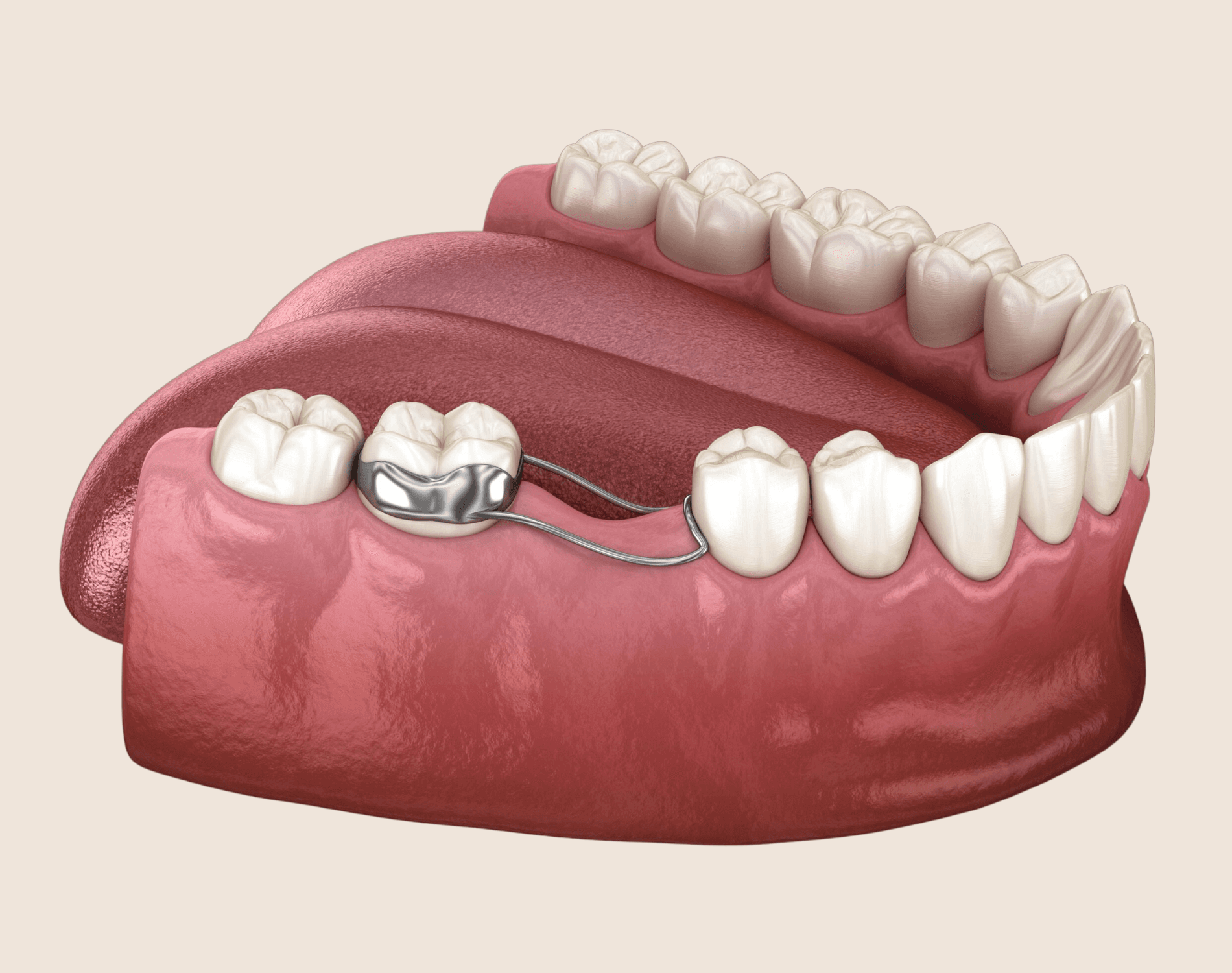
A space maintainer is a small custom appliance, usually a stainless steel band or crown with a wire loop, that holds open the gap left by a baby tooth lost too early. The American Academy of Pediatric Dentistry (AAPD) recognizes space maintenance as a way to prevent loss of arch length after early loss of a back baby tooth. It guides permanent teeth into their correct position and reduces the likelihood of orthodontic problems later.
How do space maintainers work?
An impression or scan of your child's mouth is used to custom-fit the appliance, which is then cemented or bonded next to the gap at a follow-up visit. It holds the space open so nearby teeth can't drift into it. As the permanent tooth gets ready to come in, it is checked on X-rays and the maintainer is removed at the right time.
What to Expect, Step by Step
- Exam & X-Rays: Dr. Elmore checks which tooth is missing, how your child's bite fits together, and on X-rays how far the permanent tooth is from coming in, to decide whether a maintainer is needed.
- Impression or Scan: An impression or digital scan of your child's teeth is taken, and a small band may be test-fitted. It takes about 20 to 30 minutes and needs no shots or drilling.
- Fitting & Cementing: At the follow-up visit, the custom appliance is checked for fit and cemented in place, which takes another 20 to 30 minutes. Most children adapt within a day or two.
- Checkups Until Removal: The maintainer is checked at regular visits, with X-rays to watch the permanent tooth. It's removed once that tooth is ready to come in.
How do space maintainers help?
Space maintainers preserve the natural spacing of teeth after an early tooth loss. They prevent a chain reaction of shifting that can lead to crowding, crooked or blocked permanent teeth and bite problems. Keeping the space now can reduce the need for more extensive orthodontic treatment later, saving time, cost and stress for your family.
Types of space maintainers
Most are fixed, cemented in place so they can't be lost. A band and loop holds the space for one missing back tooth, a lingual arch or Nance appliance holds space on both sides of the lower or upper jaw, and a distal shoe guides a first permanent molar that hasn't come in yet. Removable acrylic maintainers are an option for some older children.
Caring for Your Child's Space Maintainer
Skip Sticky & Chewy Foods: Gum, caramels, taffy, gummy candy and hard candy can bend the wire or loosen the band. Cut crunchy foods like apples and carrots into small pieces. Brush Around It Well: Food collects around the band and wire, so brush there carefully twice a day with fluoride toothpaste. A small interdental brush can help clean under the loop. Hands & Tongue Off: Remind your child not to push on the appliance with their tongue or fingers. Pulling at it or chewing on toys and pencils can bend or loosen it over time. Loose or Broken? Call: If the maintainer feels loose, bends, pokes the gum or comes off, keep the piece and call (407) 629-6464. A gap left without it can start to close.
Who It's For
Who Needs a Space Maintainer?
A Baby Tooth Lost Early
A back baby tooth can be lost early to decay, extraction or injury, years before the permanent tooth is due. When that happens, the gap needs to be held open.
Preventing Shifting
Without a maintainer, neighboring teeth can tip or drift into the empty space. This can happen within months, closing the gap before the adult tooth arrives.
Guiding Permanent Teeth
Holding the space gives the permanent tooth a clear path. It can then come in where it should instead of being blocked or pushed out of line.
Less Orthodontic Work Later
Keeping teeth aligned now can reduce the need for orthodontic treatment later. Reopening a closed space usually takes braces or another appliance.



Space Maintainers in Maitland
Custom-Fit to Hold the Space
An impression or scan of your child's mouth is used to custom-fit the appliance, which is cemented or bonded into place at a follow-up visit at our Maitland office, just north of Orlando. Each appointment takes about 20 to 30 minutes, and most children adapt quickly. We check it at follow-up visits and remove it once the permanent tooth is ready. Families from Orlando and across Central Florida come to us for children's dental care like this.
Avoid sticky and chewy foods that could loosen the appliance, and check that it stays in place.
Quiero expresar mi agradecimiento y recomendar ampliamente a la Dra Afsoon Elmore y su equipo por su excelente atención, paciencia y profesionalismo. Llevar a un niño con autismo al odontólogo puede ser todo un desafío, especialmente cuando sienten nervios, ansiedad y les cuesta cooperar durante los procedimientos. Sin embargo, la Dra y su equipo demostró una sensibilidad, dedicación y…

Francis Mendoza
Google review · Nov 2026
⭐⭐⭐⭐⭐ 5 MILLION STARS for Dr. Elmore and her amazing team! ⭐⭐⭐⭐⭐ I honestly cannot say enough wonderful things about Dr. Elmore and her entire team. My son is autistic, non-speaking, and requires special care when it comes to medical and dental procedures. He has been under Dr. Elmore’s care multiple times over the past few years, and every single experience has been absolutely amazing. Dr…

M C
Google review · Sep 2026
Dr. Elmore es una dentista exepcinal, especialmente con niños de necesidades especiales. Mi hijo tiene autismo y sindrome de Down, asi que no es facil encontrar a dentistas que trabajen bien con estos niños. La Dr. Elmore tambien tiene un niño con autismo asi que sabe como tratarlos. Si necesitan, puede hacer el trabajo dental bajo anestecia en el hospital. Ella es una doctora que se preocupa…

Zuimdie Guerra
Google review · Sep 2026
Dr A Elmore staff and services were 2nd to none. I recommend her to everyone especially if your child has specific dental needs she and her staff were very accommodating, professional and super nice. We really appreciate you thank you so much for a great visit 😄

James Franceschetti Jr.
Google review · Sep 2026
Amazing experience. Dr. Afsoon made sure we understood the process and answered all our questions over the phone as well as the day of treatment. Everything was smooth and the whole team was super profesional and kid friendly. My son never complained of pain afterwards and can now speak better and not drool as much. Thank you Dr. Afsoon and Team! Before and after pictures below 😍

Stephanie V
Google review · Sep 2026
My goodness dr. Elmore & her staff were a 10/10 truly ! Not a single bad thing to say , my son is on the spectrum & hadn’t been able to go to a dentist , dr. Elmore took such good care of him , he was super comfortable , process went smooth & they walked me through the whole process. Highly recommend !

Anilsa Ortiz
Google review · Apr 2026
My 4 year old girl has been terrified of the dentist. She has not been complaining about pain but for the past 6 months her eating habits were terrible. She finally was able to have X-rays taken, and we were confirmed that she had cavities in her molars. The entire staff at this hospital is amazing and so caring! Dr. Elmore talked me through the entire procedure and answered all my questions…

Marie Deaver
Google review · Apr 2026
We had a great experience with Dr. Elmore and her staff. Dr. Elmore took the time to listen to my concerns and answered all my questions. I felt very comfortable and confident in the care my daughter received. Highly recommended! Also wanted to thank Andrea! Due to a reaction my daughter had after a prior surgery with a different provider, I had a lot of concerns and needed to submit some extra…

Alex Larson
Google review · Feb 2026
Dr. Afsoon Elmore, DDS Is the best oral surgeon for kids that I know of. She is so caring, concerned, and most of all helpful through the surgerical process. She has always made herself available for any concerns I may have had. Thank you Dr. Elmore and your team is the best. I highly recommend Dr. Elmore for your child surgerical needs.⭐️⭐️⭐️⭐️⭐️

Jeannette Killingsworth
Google review · Aug 2025
Dr. Elmore is God sent she really did a phenomenal job I feel so grateful for the work she did on my daughter. Between the nurses before and during surgery to post op they were constantly communicating with me informing me step by step procedures and I felt super comfortable. It was my daughter’s first time ever being in surgery and I thought I was going to be scared or crying and it was the…

Vicquel Figuereo
Google review · Dec 2024
I dont have enough characters for all the flowers Dr Elmor deserves. She always goes above and beyond for each child and she remembers each one! It amazes me to see someone so personable to my son. She always showers all her patients not just my son who is autistic with gifts i love that. I tell her everytime i dont knownwhy you wont do other stuff you are beyond amazing. Surgery is always the…

June Byrd
Google review · Jun 2024
This was the best experience we have ever had with an oral surgeon. Doctor Elmore and the nurses were amazing from the time of scheduling the consultation, checking in with us to see my son’s comfort and pain level while waiting for the appointment. The morning of the office was clean, informative, helpful, and so kind. Everyone was very clear on what to expect and made sure my 4 year old was as…

Alex
Google review · Jun 2024
faq
Frequently Asked Questions
When does a child need a space maintainer?
A child usually needs a space maintainer when a back baby tooth is lost to decay, extraction or injury well before its permanent tooth is due to come in. Without one, nearby teeth can drift into the gap. Dr. Elmore checks your child's age, bite and X-rays to see whether the space is likely to close.
What happens if my child doesn't get a space maintainer?
Without a space maintainer, the teeth on either side of the gap can tip or drift into it, sometimes within months. The permanent tooth may then have too little room and come in crooked, blocked or impacted, which can lead to crowding, bite problems and more extensive orthodontic treatment later.
Does every lost baby tooth need a space maintainer?
No. According to the American Academy of Pediatric Dentistry, space loss after an early lost front baby tooth is usually minimal, so those rarely need one. Back baby molars are the main concern. If the permanent tooth is about to come in anyway, a maintainer may not be needed either; X-rays help decide.
How is a space maintainer fitted?
An impression or scan of the mouth is taken and used to custom-fit the appliance, which is then cemented or bonded into place at a follow-up visit. The process is gentle and non-invasive, usually needs no numbing shots, and most children adapt to the appliance within a day or two.
Does getting a space maintainer hurt?
No. Getting a space maintainer usually involves no shots or drilling. Your child may feel some pressure while the band is fitted, and the tooth it's attached to can feel a little tender for a day or two. A children's pain reliever and soft foods help if needed.
How long do the appointments take?
The process usually involves two short appointments. The first, for impressions or a scan, takes about 20 to 30 minutes, and the second, to cement the appliance, takes another 20 to 30 minutes. If a tooth is extracted during a comprehensive visit, we'll explain how the space maintainer fits into the overall plan.
How long will my child wear a space maintainer?
A space maintainer stays in until the permanent tooth is ready to come in, which can be several months to a few years depending on your child's age and which tooth was lost. It's checked at regular visits with X-rays to track the permanent tooth, then removed at the right time.
What foods should my child avoid with a space maintainer?
Avoid sticky, chewy and hard foods such as gum, caramels, taffy, gummy candy, hard candy, ice and nuts, which can bend the wire or loosen the appliance. Cut crunchy foods into small pieces. Check regularly that the maintainer is still firmly in place, and keep routine follow-up visits.
Will the space maintainer feel strange?
At first, yes. Most children notice the appliance with their tongue and may need a day or two to get used to it, but it quickly stops feeling unusual. It doesn't usually affect speech. Call us if a wire pokes the gum or cheek, since a small adjustment can fix it.
What should I do if the space maintainer comes loose or breaks?
Keep the appliance, don't try to put it back in yourself, and call (407) 629-6464 to schedule a visit. A loose maintainer can be re-cemented, and a broken one repaired or replaced. Don't wait long, because the space can start closing once the appliance is out.
Does insurance cover space maintainers?
Many children's dental plans cover space maintainers when a back baby tooth is lost early, since they help prevent bigger problems later. Coverage varies by plan and age. We accept most major dental insurance plans, including Florida Healthy Kids and DentaQuest, and our team verifies your benefits before treatment. FSA or HSA funds and the Sunbit payment plan can help with any remaining cost.
Where can my child get a space maintainer near Orlando?
Space maintainers are custom-fitted at our office at 668 N Orlando Ave, Suite 1008, in Maitland, just north of Orlando. Families come to us from Orlando, Winter Park, Altamonte Springs and across Central Florida, and no referral is required. Call (407) 629-6464 to schedule.
treatments
Related Treatments

Ready to Take the Next Step?
Thoughtful Dental Care for Your Child Starts Here
Our team will guide you through every step — from evaluation to treatment — with clarity and care.